
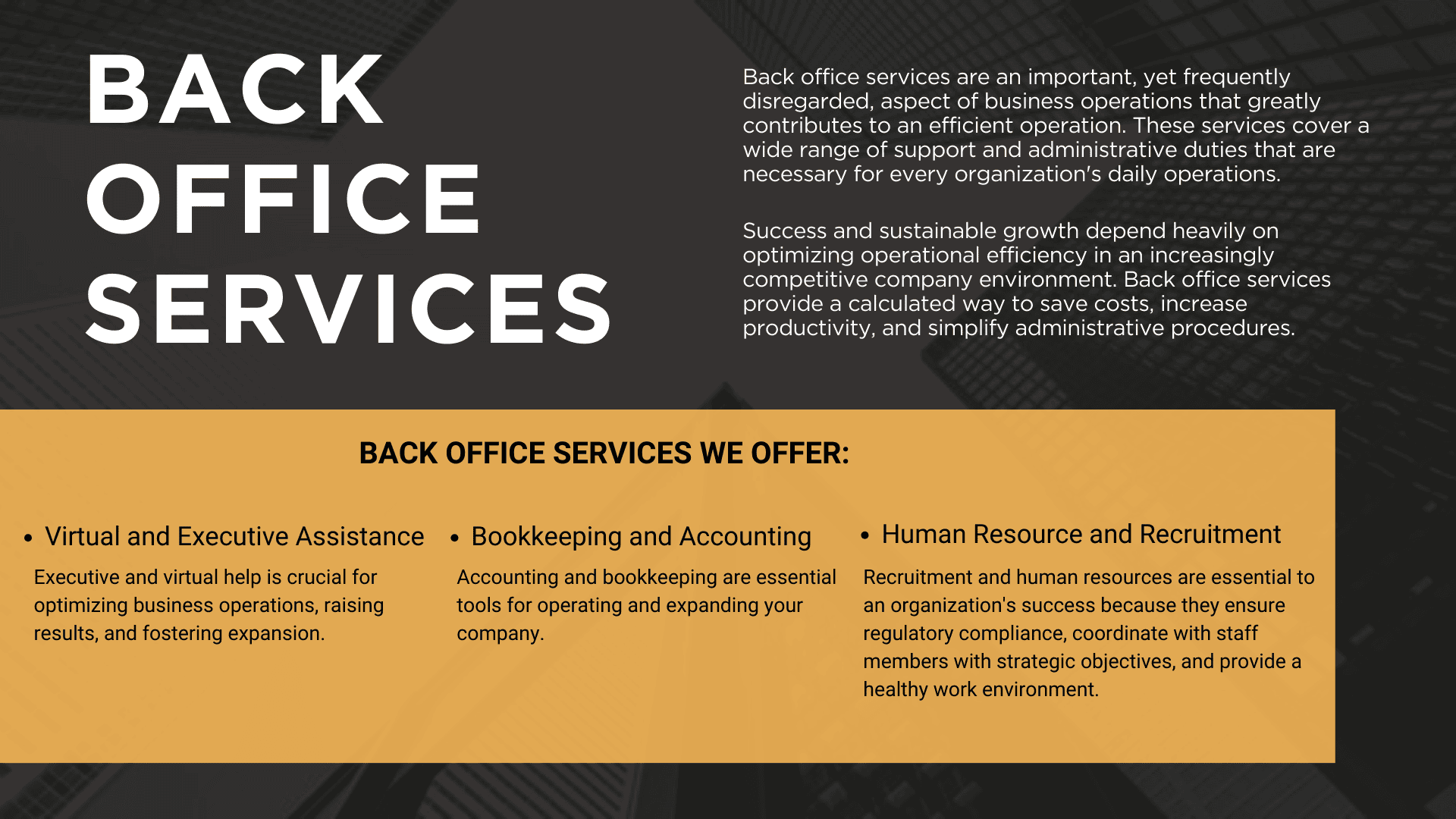
Back office services are a variety of support and administrative tasks that are necessary for a business to run smoothly but are not immediately related to dealing with clients. These services serve as the foundation of a company, giving front-end operations the support and infrastructure they need to succeed.
Outsourcing back-office tasks can significantly reduce operational costs compared to maintaining in-house departments for each function. This can result in substantial savings on overhead expenses, including salaries, benefits, and infrastructure.
By delegating administrative tasks to specialized service providers, businesses can free up valuable time and resources to focus on core activities, such as product development, marketing, and customer service, leading to increased productivity and competitiveness.
Outsourcing back office services provides access to specialized skills and expertise that may not be available internally. Service providers often have professionals with in-depth knowledge and experience in areas such as accounting, IT, and compliance, ensuring high-quality and efficient service delivery.
Back-office outsourcing allows businesses to scale their operations more easily in response to changing market demands or business growth. Service providers can adjust resources and support levels according to fluctuating needs, providing flexibility and agility to the business.
Compliance with regulations and staying updated with technological advancements can be challenging for businesses. Outsourcing back office functions to experienced service providers can help mitigate risks associated with non-compliance, data security breaches, and technological obsolescence.
EXECUTIVE AND VIRTUAL ASSISTANCE:
An executive assistant is like the right hand of a company’s top executives or managers. Their primary responsibility is to provide administrative support and ensure smooth operations within the organization. A virtual assistant (VA) provides similar administrative support but works remotely, offering flexibility and cost-effectiveness. They utilize digital tools and communication channels to carry out their tasks.
Administrative Support:
Data Management:
Project Coordination:
Communication Management:
Technical Assistance:
Personal Assistance:
BOOKKEEPING AND ACCOUNTING:
WHAT SERVICES DO BOOKKEEPING AND ACCOUNTING PROVIDE?
Recording Financial Transactions:
Bookkeeping involves accurately recording all financial transactions, including purchases, sales, receipts, and payments. This meticulous record-keeping provides the foundation for all further financial analysis.
Organizing Financial Data:
Maintaining the General Ledger:
The general ledger is the central repository of a company’s financial transactions. Bookkeepers maintain this ledger, updating it regularly to reflect the most current financial information.
Accounts Payable and Receivable Management:
Bookkeepers manage accounts payable (money owed by the company) and accounts receivable (money owed to the company). They track invoices, make payments, and follow up on overdue payments to ensure a healthy cash flow.
Payroll Processing:
Financial Reporting:
Accountants compile and analyze financial data to generate various reports, such as income statements, balance sheets, and cash flow statements. These reports provide valuable insights into the financial health of the business.
Tax Preparation and Compliance:
Accountants help businesses prepare and file their tax returns accurately and on time. They also provide guidance on tax planning strategies to minimize tax liabilities and ensure compliance with tax laws and regulations.
HUMAN RESOURCE AND RECRUITMENT:
Talent Acquisition:
Onboarding and Training:
Employee Relations:
Performance Management:
Compensation and Benefits:
Compliance and Legal Responsibilities:
Back office services, which include various support and administrative tasks essential to business success, provide the foundation of effective operations. By utilizing these services, businesses can increase cost-effectiveness, concentrate on core competencies, attain scalability, obtain specialized knowledge, and reduce risks. Whether you run a huge organization or a small startup, outsourcing back-office work can improve efficiency and stimulate long-term growth.